Catholic Church Profile

Origins of Hampton’s Catholic Community
The earliest Catholic activity in this area dates to 1839, when Father J. A. M. Pelamourgues, a French priest and the first local pastor of St. Anthony’s in Davenport, arrived with a jurisdiction that stretched from Lyons to Hampton.[i]
The records of that church preserve names such as Vogel, Yost, Mohr, Weigand, Scherschall, and others. Tradition holds that Father Palamourgues traveled to Hampton about twice each year to baptize and confirm children and to celebrate Mass.[i] In 1938, Nicholas Mohr recalled one such visit, though he could no longer remember in which house the Mass had been offered.
By about 1845, after the Hampton ferry began operating, some local Catholics crossed to Iowa and walked on to Davenport to attend Mass.[i] Although the identity of Hampton’s first Catholic is unknown, by 1845 to 1855 a considerable number had settled in and around Hampton and Rapids City. Around Hampton were the five Mohr brothers, Jacob, Peter, John, William, and Paul, along with Nicholas Mock, Michael Hoffman, Christopher Weigand, Joseph Thomas, Henry C. and Peter Glanz, and Anton Kiefer. Around Rapids City were the Buckleys, Scherschalls, Gumbers, Schniders, Colemans, and Mrs. Hofstetter. A Mr. Schall of Port Byron also belonged to this early circle.
These men and women formed the foundation of the church. After the Civil War, Joseph Hermes arrived, and his family alone provided a strong beginning for a growing congregation. The names preserved in the early church records represent families that became the nucleus of the church’s organization. In 1856, St. Joseph’s Catholic Church was dedicated in Davenport, and Father Niermann, its German priest, traveled to surrounding towns to celebrate Mass and occasionally came to Hampton in those early years. He also officiated at the wedding of Joseph Hermes and Mary Mohr.
Father John G. Alleman and Early Parish Formation
Catholics first gathered as an organized community under the spiritual leadership of Fr. John G. Alleman in the 1850s. Born on December 3, 1804, in Alsace, France, Fr. Alleman was preparing for the priesthood in 1832 at the Dominican Priory at St. Rose, Kentucky.[i] Fluent in German, English, and French, he was particularly well-suited to missionary work in the United States. He received the Sacrament of Holy Orders in June 1834, but after a series of difficulties, he was expelled from the Dominican Order. That setback did not weaken his vocation. Instead, he began again as a secular priest in the Diocese of Dubuque, where Bishop Loras appointed him pastor in Fort Madison, Iowa. His parish territory extended into parts of Western Illinois.
By 1851, Fr. Alleman’s responsibilities had shifted. Rt. Rev. William Quarteres, the first Bishop of Chicago, urged him to devote himself to that diocese, and Fr. Alleman chose Rock Island as the center of his apostolate. He threw himself into the construction of a new limestone church on the site where St. Mary’s church and rectory in Rock Island now stand. Dedicated to St. James, its cornerstone was laid on August 31, 1851. Soon afterward, with the help of Fr. John P. Donelson, he helped lay a firm foundation for St. Mary’s, St. Joseph’s, Sacred Heart, and St. Paul’s churches. He also planted the roots of the Catholic Church in Moline, where the first church, a frame structure dedicated to St. Anthony, was completed in 1857. After St. Anthony’s came St. Mary’s, Sacred Heart, and Holy Trinity in Moline, along with St. Mary’s and St. Anne’s in East Moline. During this same period, Fr. Alleman organized Immaculate Conception Church in Hampton, later known as St. Mary’s, Holy Name in Coal Valley, St. John the Baptist in Rapids City, and St. Patrick’s in Edgington. Twice a month he celebrated Sunday Mass at St. Joseph’s; on the alternate Sundays, he celebrated Mass at Nauvoo. In the last seven years of his ministry alone, he established seven mission churches.
A Dominican friar and a physically imposing man, he thought nothing of walking from Rock Island to Hampton to celebrate Mass; with his long stride, the journey seemed easy to him. On one occasion, Jacob Mohr, the shoemaker, noticed how worn Fr. Alleman’s boots had become and decided to make him a new pair.
Around 1865, the Hampton community formed a regular church organization and built a church of its own. One of the Mohr boys later remembered a story told by his parents: Father Alleman and the women of the parish picked blackberries from the surrounding hills to raise a few dollars to begin the church fund.[ii]
As the Catholic population grew, two churches were formally established: St. Mary in 1865 and St. John in 1878. St. John’s began as a mission of St. Mary, but as the membership at St. John eventually grew larger than that of St. Mary, the relationship was later reversed.
Parish Growth, Consolidation, and Change
This history centers on St. John the Baptist Catholic Church in Rapid City, Illinois, while also tracing the closely connected story of St. Mary’s Catholic Church in Hampton, Illinois, which for many years formed part of the combined parish. Read together, these two communities reveal how Catholic life in this part of the Illinois Quad Cities grew from scattered missionary visits into organized parish life, endured periods of rebuilding and consolidation, and adapted to changing local conditions across nearly two centuries.
Mission Foundations Before Consolidation (1851–1880)
From 1851 to 1856, Catholic missions took shape at Port Byron, Rapid City, and Hampton, extending the work that Father John G. Alleman was carrying across the region.
In Rapid City, the church was constructed by Peter Gumber with the help of coal miners and others from the surrounding area. Coal mining was then the principal occupation in the Rapid City area, and it was reported that about 1,500 miners, together with their families, lived there.[iii]
Between 1851 and 1856, Father John G. Alleman conducted missions in Rapid City, Port Byron, and Hampton, helping bind these emerging Catholic communities into a wider regional network.
Rapid City Mission
The original church at Rapid City was built in 1878 on land donated by Jacob Vegal.[iv]
Hampton Mission
After an initial missionary period, Hampton received its first permanent pastor in Rev. Joseph Abt, who served from 1861 to 1871.[v] He was followed in 1872 by Rev. Joseph Beineke, who remained until 1876, and then by Rev. Herman Greve, Hampton’s last resident pastor, who served from 1877 to 1879.
The original church stood near the farm of George H. Wilkin.[i] Beside the churchyard was a cemetery that still contains some graves, though most of the remains were later moved to Rapid City Cemetery. The church itself was still standing in 1879; when the Hampton public school burned down that year, classes were held in the old Catholic church.
That same year, 1879, a second Catholic church was built. It was a frame building located on the northeast corner of Pearl and Locust Streets, on the same site as the church pictured above, though it faced west. It cost $2870.

c. 1940 Constructed in 1900
Around 1900, it was destroyed by a fire of unknown origin, and a third church, today’s church, was later built in its place. Jacob Mohr, one of the church’s most active members, also once taught German in his home as a kind of parochial school.
Consolidation of the Rapid City and Hampton Churches (1880)
In 1880, after Father Miller left St. John’s Parish in Rapid City and after the newer church had been built in Hampton, the two churches were consolidated. St. John the Baptist Catholic Church became the principal parish, and Hampton became a mission of Rapid City.[vi] In fact, St. Mary’s Catholic Church in Hampton had already been functioning as a mission of Rapid City since Hampton’s last resident pastor departed in 1879.[vii]
The succession of pastors after consolidation reflects both continuity and change in the life of the combined parish:
- Rev. Henry Boers, pastor from 1880 to 1888
- Rev. Sebastian Thiebes, 1888 to 1895
- Rev. A. Geyers and Rev. C. Hopesch, 1895 to 1898
- Rev. Vincent Hellstern, 1898 to 1906
- Rev. R. LeBon, 1906
- Rev. Joseph Flanagan, 1906 to 1910
- Rev. Edward Kniery, 1910 to 1912
- Rev. Frederick Hogben, 1912 to 1919
- Rev. P. J. Roach and Rev. E. J. Sheedy, 1919 to 1921
- Rev. E. C. Leonard, 1921 to 1924
- Rev. Michael Tracy, 1924 to 1940
- Rev. Hartin Cohlin, 1940 to 1943
- Rev. Mankowski, 1943 to 1950
- Rev. Richard Moran, 1950 to 1973; he arrived as assistant pastor and became pastor after the death of A. Mankowski.
- Rev. John Gaughran, 1973 to 1995
- Rev. James DeBisshop, 1995 to 2007
- Rev. Steve Loftus, 2007 to 2011
- Father Glen H. Harris, 2011 to 2024
- Rev. Julien Esse, 2024 to the present
Construction and Expansion After Consolidation
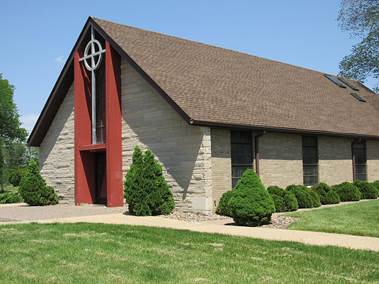
c. 2025 Constructed in 1952
Under the guidance of Fr. Richard Moran, a new building program began in the 1950s. St. Mary Church was the first structure completed in 1953.[ix] The old Hampton church was subsequently sold and moved to the Methodist Church, where it still stands attached to the main sanctuary.[viii]

c. 2026 Building Attached to Methodist Church
The present church and rectory at St. John were built in 1972, and Fr. John Gaughran became pastor in 1973, remaining for the next 22 years. In 1978, a church hall was built at St. Mary. Then, in 1991, St. John added a new parish center, and in the process the old church and rectory, which had until then been used as meeting space, were torn down.
The new St. John the Baptist church in Rapid City was established in 1971 and dedicated in 1972, and a new rectory followed in 1973.[x] The former Rapid City church was redecorated and restored for the parish’s social functions, while the old rectory was similarly refurbished to serve as a religious center. Both buildings have since been razed to make room for other buildings and parking.
The new church was built larger than the old one so that it could accommodate the parish’s growing population.[xi] By 1974, the parish counted 196 families, while St. Mary’s in Hampton had a membership of 116. Together, the two churches had a total membership of 312.[xii]
Recent Contraction and Enduring Legacy
In 2023, the story entered another period of change. Because of declining participation and a steep drop in the number of men seeking a lifelong priestly commitment, the Diocese of Peoria chose to downsize and consolidate both churches, along with St. Anne’s Parish. At the same time, the Hampton community was experiencing economic stagnation brought on by industrial downsizing and factory relocations. St. Mary’s celebrated its last Mass in Hampton in the spring of 2025. St. John’s remains.
The long history of these churches is, in the end, a story of persistence: missionary priests covering vast territory, families sustaining worship across generations, congregations building and rebuilding, and parish life adjusting to new realities. Though St. Mary’s in Hampton no longer holds regular worship, its history remains inseparable from that of St. John the Baptist in Rapid City, and together they continue to reflect the enduring Catholic presence in this region.
In summary, the history of St. Mary’s in Hampton and St. John the Baptist in Rapid City reflects the development of Catholic life in this region from missionary beginnings to established parish communities, through periods of growth, consolidation, rebuilding, and eventual contraction. Guided by devoted clergy and sustained by generations of local families, these churches shaped the religious life of their communities and left a lasting legacy that endures even as their forms have changed.
Endnotes
[i] George McNabney, History of Hampton, Vol. 1 (1938).
[ii] Ralph Buckley and Leo P. Brennan, report, Port Byron, Illinois, May 23, 1974.
[iii] Ralph Buckley and Leo P. Brennan, report, Port Byron, Illinois, May 23, 1974.
[iv] Ralph Buckley and Leo P. Brennan, report, Port Byron, Illinois, May 23, 1974.
[v] Ralph Buckley and Leo P. Brennan, report, Port Byron, Illinois, May 23, 1974.
[vi] Ralph Buckley and Leo P. Brennan, report, Port Byron, Illinois, May 23, 1974.
[vii] Ralph Buckley and Leo P. Brennan, report, Port Byron, Illinois, May 23, 1974.
[viii] Ralph Buckley and Leo P. Brennan, report, Port Byron, Illinois, May 23, 1974.
[ix] St. John the Baptist Church St. John the Baptist Church website (Our Lady of Guadalupe Parish), 2026.
[x] Ralph Buckley and Leo P. Brennan, report, Port Byron, Illinois, May 23, 1974.
[xi] Ralph Buckley and Leo P. Brennan, report, Port Byron, Illinois, May 23, 1974.
[xii] Ralph Buckley and Leo P. Brennan, report, Port Byron, Illinois, May 23, 1974.